dumpstool logo

An implementation engineer needs to perform an upgrade of IdentityIQ between releases.
Is the following statement true?
Proposed Solution:
All custom branding changes will automatically be updated through the upgrade process.
Is this statement correct about writing and executing source mapping rules to populate identity attributes?
Solution: The rule type must be IdentityAttribute.
Can an Escalation Rule be used to handle this scenario?
If an access review has not been completed within 7 days, re-assign it to the certifier ' s manager.
Proposed Solution:
Is the following statement true?
Solution: All Application objects must have an Identity object as the owner.
Is the following statement true about out-of-the-box reporting?
Proposed Solution:
All IdentityIQ report results are stored on IdentityIQ application servers.
Can the search type in Syslog be used to accomplish this result?
Solution: Identifying details of a system error presented in the Ul
Is the following statement about IdentityIQ rule inputs and outputs correct?
Proposed Solution:
For ease of implementation, all BeanShell rules in IdentityIQ have the same input and output variables.
Can the following be achieved via configuration of control variables in the out-of-the-box Lifecycle Manager (LCM) workflows?
Solution: Specify which access items may be requested.
Is this statement true about IdentityIQ ' s syslog event searching capabilities?
Proposed Solution:
When searching the syslog events from the Advanced Analytics page, it is not possible to search syslog events by attributes other than an Incident Code.
Can the search type in Syslog be used to accomplish this result?
Solution: Identifying all Link objects from a particular application
Is the following a valid role option that can be configured?
Proposed Solution:
Configure a role to include a set of permissions.
Is this a default functionality of the Lifecycle Manager (LCM) module?
Proposed Solution:
Launch Certification Campaign
The engineer is writing code to modify Policy objects. Is this the correct way to get, lock, modify and save the object, given the name of the object?
Proposed Solution:
public void updateObject(SailPointContext context, String objectName) throws GeneralException {
Policy object = context.getObjectByName(Policy.class, objectName);
// ... modify object ...
context.lockObject(object);
context.decache(object);
context.commitTransaction();
}
An engineer needs to first create a custom audit event and then set up an associated report.
What are four steps to accomplish this goal?
Proposed Solution:
Create a Custom Certification Event Schedule and associated ruleRunner task.
Is this statement true about the Application, Identity, ManageAttribute, Bundle, and Link objects in IdentitylQ?
Solution: An Application object is not required to aggregate external user account information into IdentitylQ.
A bank is two years into an ongoing project to provide all access through roles. The bank is actively using roles and actively adding to their role model. They need to ensure that all roles include the correct entitlements.
Will this certification type achieve the goal?
Solution: Application Owner Certification
Is this a piece of information that an engineer needs when initially setting up a new IdentityIQ sandbox environment?
Proposed Solution:
the number of identities the customer has
Is the following statement about IdentityIQ rule inputs and outputs correct?
Proposed Solution:
for (int i = 0; i < this.variables.length; i++) {
String name = this.variables[i];
Object value = eval(name);
if (value == void)
print(name + " = void " );
else if (value == null)
print(name + " = null " );
else
print(name + " : " + value.getClass().getSimpleName() + " = " + value);
}
This debug code will print all available inputs and outputs for a BeanShell rule.
A manager wants to extend the access granted to an employee.
Is this a default role type that is available for the manager to request in IdentityIQ during the access request process?
Proposed Solution:
IT Role that is inherited from an assigned Business Role
A client needs a custom quicklink, which only managers can launch, in order to launch a simple workflow. Is this a valid step to take during the development of this custom quicklink?
Solution: Insert the " Managers " quicklink population as the dynamic scope in the quicklink object.
Is the following statement about workflow step types and their usage true?
Solution: When a wait step is encountered in a foreground workflow, the user will notice this, because the screen will freeze for the specified number of seconds.
Is the following statement true about out-of-the-box reporting?
Proposed Solution:
Reports can be scheduled to run at most once per day.
The engineer is analyzing on a workflow Transition.

The following variable values are known:
Will the workflow continue to this step?
Solution: Approve
A client needs a custom quicklink, which only managers can launch, in order to launch a simple workflow.
Is this a valid step to take during the development of this custom quicklink?
Proposed Solution:
Place a quicklink object on the workflow that is to be launched.
Is this a true statement about localization support in IdentitylQ?
Solution: The language displayed in the user interface is always based on the default language selected in the global settings.
Is the following statement true?
Proposed Solution:
All ManagedAttribute objects associated to an Identity can be viewed on the ‘Policy’ tab from ‘View Identity’ QuickLink.
Is the following statement about workflow step types and their usage true?
Proposed Solution:
A script or rule step uses BeanShell code to perform the step action.
IdentityIQ has been installed and set up with the contents of IdentityExtended.hbm.xml.
Is this a correct statement about the installation?
Proposed Solution:
An unlimited number of additional searchable placeholder extended attributes can be added to this installation beyond the 10 shown.
Is the following true of Identity Provisioning Policies?
Solution: Identity Provisioning Policies can be used to include allowed-values definitions or validation logic on fields so that only valid/authorized values can be specified for those fields when using the Create Identity feature to add an identity.
Is this a valid step to take when importing SailPoint XML file objects into IdentityIQ?
Proposed Solution:
Select the file from Global Settings > Import From File.
Is the following statement about workflows and sub-workflows (subprocesses) true?
Proposed Solution:
Sub-workflows can be used to simplify large workflows.
Can the following be achieved via configuration of control variables in the out-of-the-box Lifecycle Manager (LCM) workflows?
Proposed Solution:
Specify which applications support password change requests through the IdentityIQ user interface.
The engineer is working on a workflow implementation.
After a form step, the workflow can transition to three steps:
Stop if the Reject (back) button is used,
Audit if the Approve (next) button is used and the field named comment is returned from the form to the workflow variable comment and has a value,
Provision otherwise.
The engineer writes the transitions in XML code.
Is this a valid implementation?
Proposed Solution:
< Transition >
< Source >
if (!approved) return " Stop " ;
if (comment) return " Audit " ;
return " Provision " ;
< /Source >
< /Transition >
Can a Account Group be used for the following scenario?
Proposed Solution:
Aggregating a specific set of accounts on an ' Account Aggregation ' .
The engineer is configuring a new application definition.
Due to company mergers, the customer has several different formats for employee number. The customer needs to match on the manager employee number to the manager identity, taking all of these formats into account.
Is this the rule an engineer should write to accomplish the goal?
Proposed Solution:
Write a Correlation rule.
Is this statement true about the IdentityIQ Audit functionality and/or options?
Proposed Solution:
The built-in audit options allow for auditing of Identity Attribute Changes.
Can the following be achieved via configuration of control variables in the out-of-the-box Lifecycle Manager (LCM) workflows?
Proposed Solution:
Treat the provisioning process as a successful event when it is in a queued status.
Is this statement true about the IdentityIQ Audit functionality and/or options?
Proposed Solution:
The majority of IdentityIQ’s auditing is managed through the Audit Configuration page in the UI.
Is this statement valid regarding the control and usability of the Debug pages in IdentitylQ?
Solution: The current version and patch level of IdentitylQ can be found through the Debug-About page.
Can the following action be performed using Rapid Setup application onboarding?
Solution: Specify account correlation by mapping an identity attribute to an account attribute.
Is this a purpose of an IdentitylQ certification?
Solution: to certify user expense reports
Is the following statement true?
Proposed Solution:
All ManagedAttribute objects can have an Identity object as the owner.
Can the Provisioning tab under " Administrator Console " be used to do the following task?
Proposed Solution:
View all failed, pending, successful provisioning transactions.
Assuming that the policy violation owner has the necessary permissions, is this a valid option for the policy violation owner to use when acting on a policy violation of type ' Account Policy ' ?
Proposed Solution:
Schedule Policy Composition Certification
Is the following statement about IdentityIQ rule inputs and outputs correct?
Proposed Solution:
Every BeanShell rule in IdentityIQ rule must produce output.
Is the following statement true about out-of-the-box reporting?
Proposed Solution:
All out-of-the-box reports in IdentityIQ are stored as TaskDefinition objects.
Is the following statement about workflow step types and their usage true?
Proposed Solution:
A step with the attribute wait= " 1 " will cause the workflow to wait for at least one minute. The workflow will be revived on the next run of the Perform Maintenance Task, after the wait period is over.
Is this statement true about email templates or behavior within them?
Solution: Whole paragraphs cannot be included or omitted based on conditional tests, such as #if (SremindersRemaining > 0). Only individual lines can be omitted in this manner.
Is this what should be performed in order to generate the database script to extend Application attributes in the IdentitylQ database on the initial installation?
Solution: Add the new object attribute to the Application ObjectConfig in IdentitylQ.
Can this be achieved using Rapid Setup user interface configuration options?
Solution: Reassign all object ownership to the user ' s manager during Leaver and Termination events.
An engineer is assigned to configure an account attribute. The requirements are:
Purpose: Flag privileged accounts
Read from: Financial application, privileged attribute
Calculate from: Keystore application, responsibility-code attribute
Usage 1: Display as option in Advanced Analytics
Usage 2: Use when writing rules
Usage 3: Include in policies
Does the engineer need to set this configuration option on the account attribute to meet the requirements?
Proposed Solution:
Attribute Type: string
IdentityIQ has been installed and set up with the contents of IdentityExtended.hbm.xml as follows:
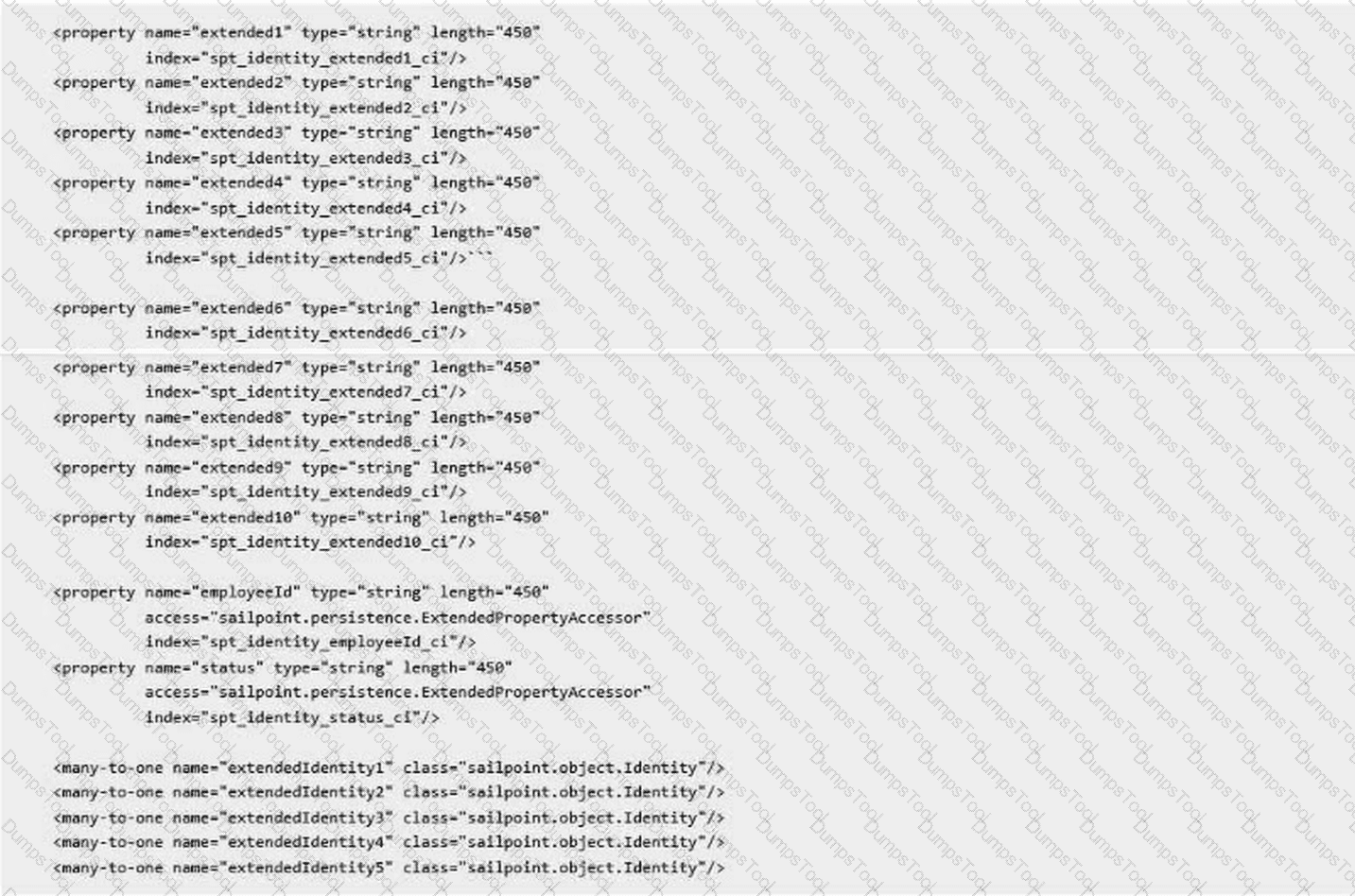
Is this a correct statement about the installation?
Proposed Solution:
Only two identity attributes have been defined in this scenario: employeeId and status. This installation will not have necessary attributes, such as firstname and lastname.
IdentityIQ has been installed and set up with the contents of IdentityExtended.hbm.xml as follows:
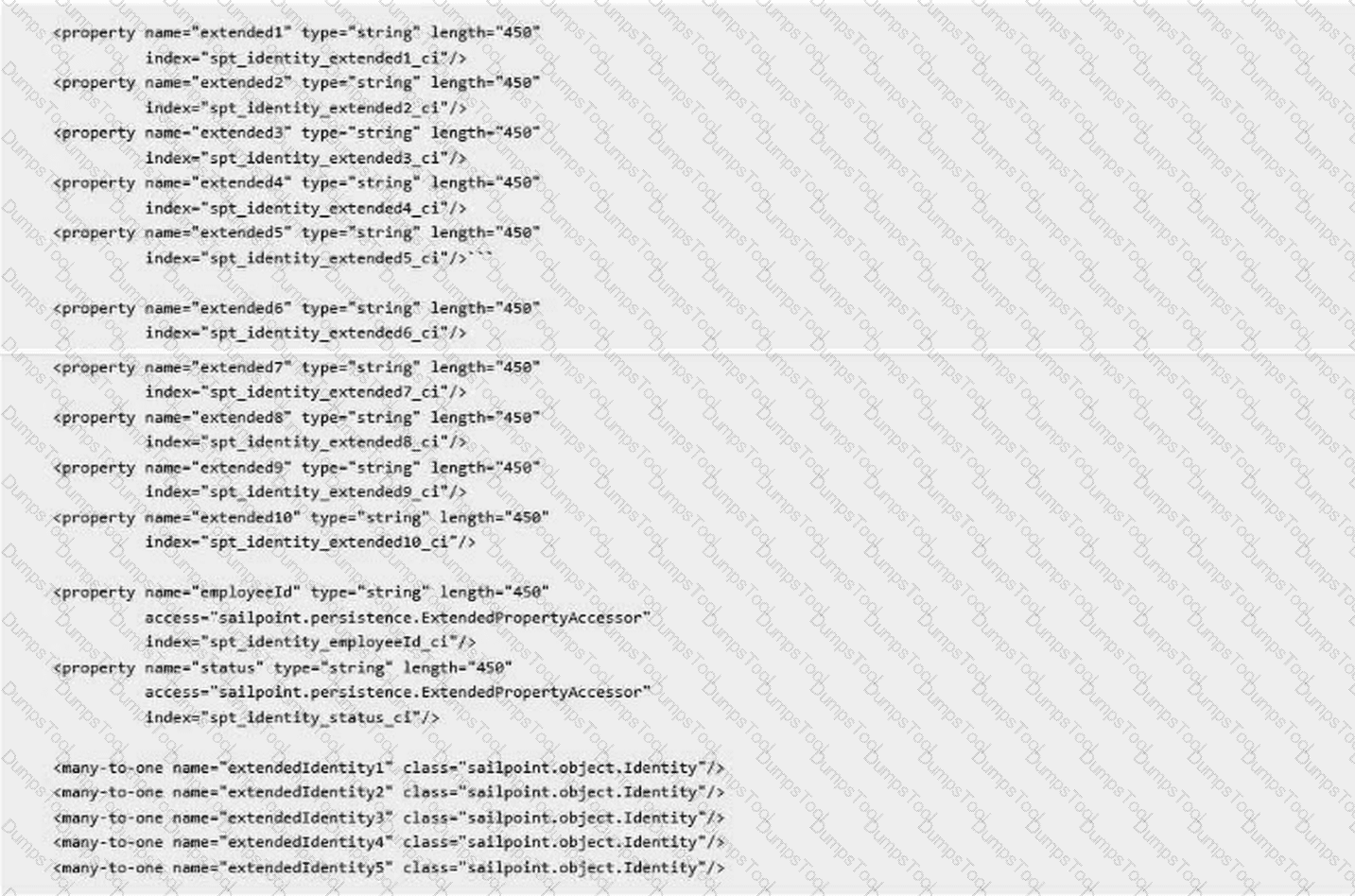
Is this a correct statement about the installation?
Proposed Solution:
To store an image for each identity in an extended attribute, the length property in the extended attribute definition should be set to 9000.
Is the following statement true?
Solution: Every Link object must be associated to an Identity object
Is the following a true statement about IdentityIQ authentication and authorization?
Proposed Solution:
What users are authorized to do and see in IdentityIQ is partly controlled via the capabilities they have, which can be assigned directly to their identity.
The engineer is writing code to modify Policy objects. Is this the correct way to get, lock, modify and save the object, given the name of the object?
Proposed Solution:
public void updateObject(SailPointContext context, String objectName) throws GeneralException {
Policy object = ObjectUtil.transactionLock(context,
Policy.class, objectName);
// ... modify object ...
context.saveObject(object);
context.commitTransaction();
}
IdentitylQ is using emails to notify users about completion of steps within a process, or actions that need to be addressed.
To ensure this notification is working, a main configuration must be set up in IdentitylQ to provide mail server and mail server authentication details.
Is this a required setting that an engineer must set up in IdentitylQ in order to ensure successful communication with the SMTP server?
Solution: Email Protocol
Can the following be achieved via configuration of control variables in the out-of-the-box Lifecycle Manager (LCM) workflows?
Proposed Solution:
Check if an access request would violate any policies, and allow the requester to review before submitting.
Can the following IdentitylQ object be extended to store client-specific data by updating the corresponding .HBM file?
Solution: Link
Is this configuration option required when an engineer sets up any application?
Proposed Solution:
Identity Attribute
Is this statement true about certifications?
Solution: The staging period is required.
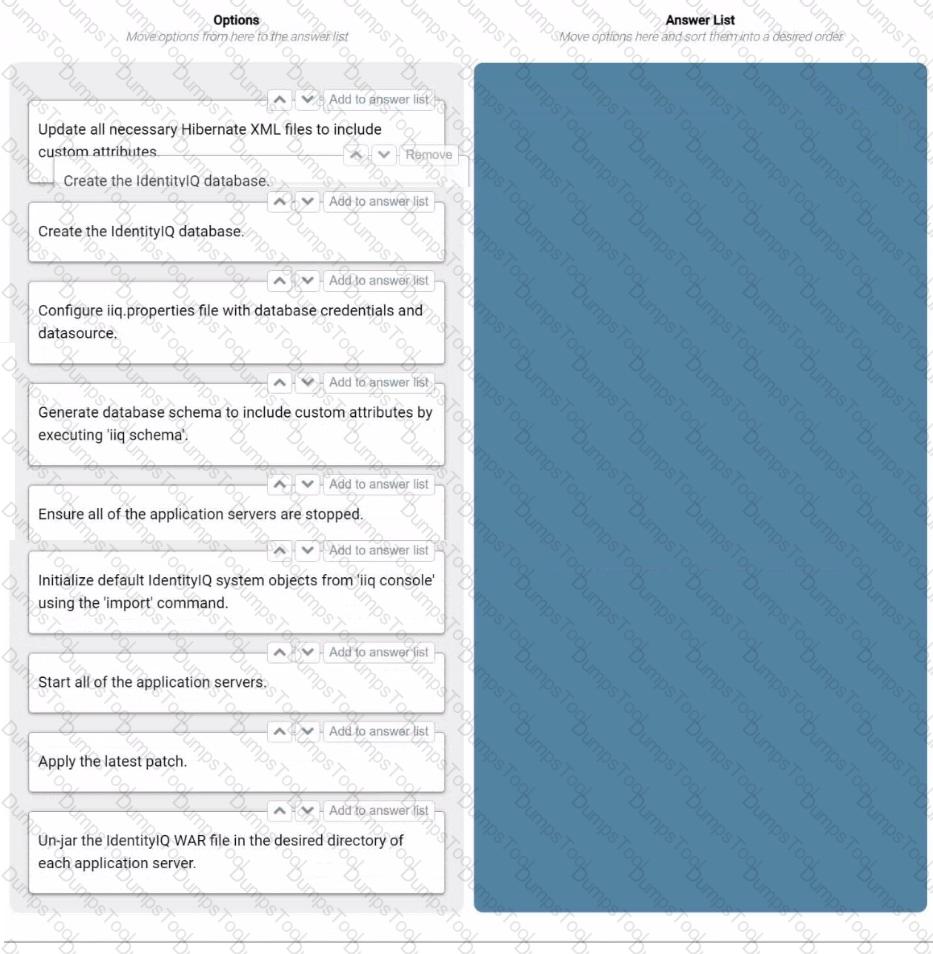
An implementation engineer needs to perform an initial installation of identitylQ.
Drag the options from the left into the answer area on the right, and place them in the correct order.
A customer wants to make changes in their IdentityIQ user interface.
Consider branding and other IdentityIQ UI changes. Is this statement valid?
Proposed Solution:
The original HTML file is updated to change the settings.
For a user who already has an account on an application and wants to be able to request access to a new account through Manage User Access, does this configuration need to be performed in Lifecycle Manager (LCM)?
Proposed Solution:
Select “Allow requesting new accounts” in the Manage Accounts QuickLink configuration for the user’s QuickLink population.
Is the following statement about workflow step types and their usage true?
Proposed Solution:
A catch step must accompany every step in a workflow that can potentially throw an exception.
Is this a true statement about localization support in IdentitylQ?
Solution: Localized messages can be retrieved from custom Java/BeanShell code using SailPoint APIs.
An organization is making a change at the regional level.
Many users of a financial system have incorrect entitlements. Some users are missing entitlements, and some users have excess entitlements. Work needs to be performed to clean up access.
Is this one of the IdentityIQ batch request types that can help meet this goal?
Proposed Solution:
Create Entitlement
An implementation engineer needs to perform an upgrade of IdentityIQ between releases. Is the following statement true?
Proposed Solution:
When a method is deprecated in the upgraded IdentityIQ version, the method references in custom code will be automatically updated.
Is the following statement about IdentitylQ rule inputs and outputs correct?
Solution: The lypical input variables for a rule are listed in the BeanShell rule editor in IdentitylQ, based on the rule registry.
For a user who wants to be able to unlock an account for a subordinate or themselves through Manage Accounts, does this configuration need to be performed in Lifecycle Manager (LCM)?
Proposed Solution:
Select the Rehire action under Manage Accounts Options in the LCM Configuration.
The engineer is configuring a new application definition.
The customer wants an Audit record to be created with the error message, if provisioning fails.
Is this the rule an engineer should write to accomplish the goal?
Solution: Write an AfterProvisioning rule.
Is the following statement about IdentityIQ rule inputs and outputs correct?
Proposed Solution:
The default description of a Rule, which originates from the Rule Registry, usually provides information about the Rule ' s purpose and its expected output.
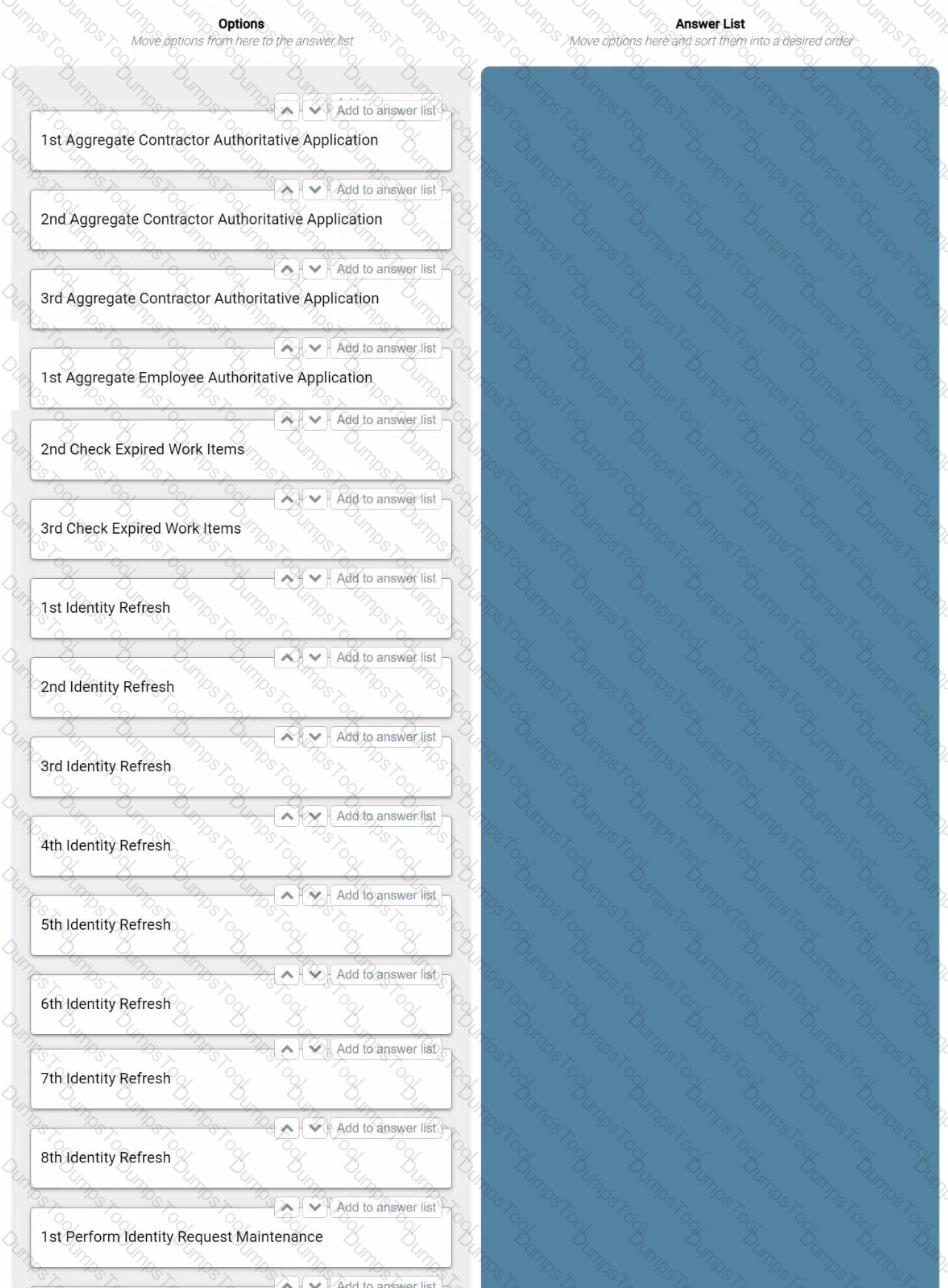
How should an engineer schedule the tasks to most efficiently achieve the following goals?
Goals:
• Process the Employee Authoritative application at 5:00 AM and 12:00 PM.
• Process the Contractor Authoritative application at 5:10 AM and 12:10 PM.
• Process the Active Directory application at 5:20 AM and 12:20 PM.
• Process the Finance application at 8:00 PM.
• Check for expired work items at 12:00 AM.
• Perform identity request maintenance at 2:00 AM.
Schedule parameters:
• Each application aggregation takes anywhere between 30 minutes and 2 hours.
• The run schedule is for a 24-hour period, which begins at 12:00 AM.
Instructions:
• Drag the required tasks from the left into the answer area on the right, and place them in the correct order, starting at 12:00 AM.
• Ordinal numbers (such as 1st, 2nd, and 3rd) in the options indicate which run of the day it is for the task type.
• There will be unused task options.
Is this a purpose of an IdentitylQ certification?
Solution: to attest lo a user ' s system access
A customer wants to make changes in their IdentityIQ user interface.
Consider branding and other IdentityIQ UI changes. Is this statement valid?
Proposed Solution:
If SailPoint is removed from the header bar, “Powered by SailPoint IdentityIQ” must be added to the copyright footer.

TESTED 26 Sep 2026

