dumpstool logo

You need to create a Conditional Access policy to meet the security require-ments.
How should you configure the policy? To answer, select the appropriate options in the answer area.

You need to configure a conditional access policy to meet the authentication requirements.
What should you include in the policy configuration? To answer, select the appropriate options in the answer area.
NOTE Each correct selection is worth one point.

You need to implement network security to meet the security requirements and the performance requirements.
Which two actions should you perform? Each correct answer presents a complete solution.
NOTE: Each correct selection is worth one point.
You need to configure the user settings of Admin1 to meet the user profile requirements.
What should you do?
You need to recommend a DNS infrastructure that meet the performance requirements. What should you recommend? To answer, select the appropriate options in the answer area. NOTE: Each correct selection is worth one point.

You need to modify the custom virtual machine images to meet the deployment requirements.
What should you install?
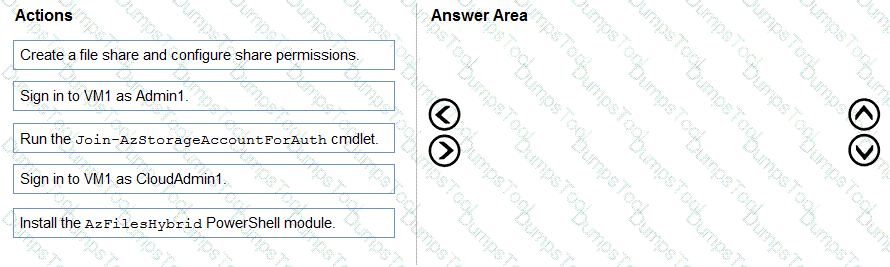
You need to ensure that you can implement user profile shares for the Boston office users. The solution must meet the user profile requirements.
Which four actions should you perform in sequence? To answer, move the appropriate actions from the list of actions to the answer area and arrange them in the correct order.
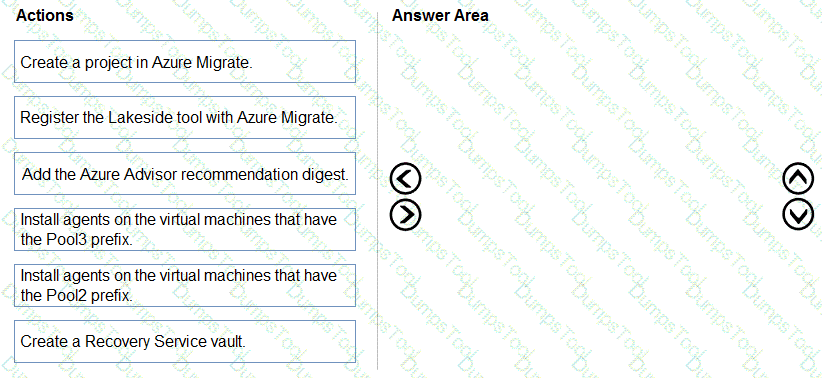
You need to evaluate the RDS deployment in the Seattle office. The solution must meet the technical requirements.
Which three actions should you perform in sequence? To answer, move the appropriate actions from the list of actions to the answer area and arrange them in the correct order.
You plan to implement the FSLogix profile containers for the Seattle office.
Which storage account should you use?
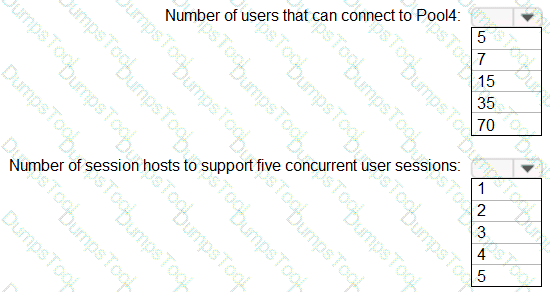
You are planning the deployment of Pool4.
What will be the maximum number of users that can connect to Pool4, and how many session hosts are needed to support five concurrent user sessions? To answer, select the appropriate options in the answer area.
NOTE: Each correct selection is worth one point.
Which three PowerShell modules should you install on Server1 to meet the technical requirements? Each correct answer presents part of the solution.
NOTE: Each correct selection is worth one point.
You need to recommend an authentication solution that meets the performance requirements.
Which two actions should you include in the recommendation? Each correct answer presents part of the solution.
NOTE: Each correct selection is worth one point.
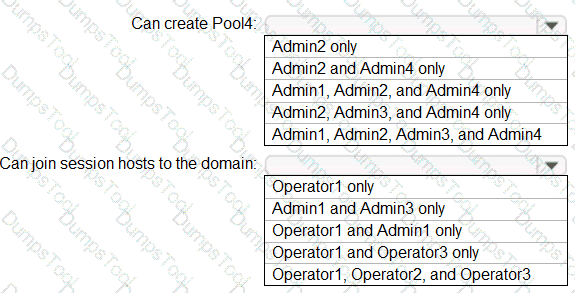
Which users can create Pool4, and which users can join session hosts to the domain? To answer, select the appropriate options in the answer area.
NOTE: Each correct selection is worth one point.
You need to configure the virtual machines that have the Pool1 prefix. The solution must meet the technical requirements.
What should you use?
Which role should you assign to Operator2 to meet the technical requirements?
You need to configure the device redirection settings. The solution must meet the technical requirements.
Where should you configure the settings?
You plan to deploy Windows Virtual Desktop to meet the department requirements shown in the following table.

You plan to use Windows Virtual Desktop host pools with load balancing and autoscaling.
You need to recommend a host pool design that meets the requirements. The solution must minimize costs.
What is the minimum number of host pools you should recommend?
Note: This question is part of a series of questions that present the same scenario. Each question in the series contains a unique solution that might meet the stated goals. Some question sets might have more than one correct solution, while others might not have a correct solution.
After you answer a question in this section, you will NOT be able to return to it. As a result, these questions will not appear in the review screen.
You have an Azure Virtual Desktop host pool that runs Windows 10 Enterprise multi-session.
User sessions are load-balanced between the session hosts. Idle session timeout is 30 minutes.
You plan to shut down a session host named Host1 to perform routine maintenance.
You need to prevent new user sessions to Host1 without disconnecting active user sessions.
Solution: From the host pool, you remove Host1 from the session host list.
Does this meet the goal?
Your network contains an on-premises Active Directory domain that syncs to a Microsoft Entra tenant. The domain contains the users shown in the following table.

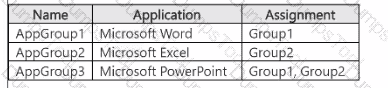
You have a Azure Virtual Desktop deployment that contains the application groups shown in the following table.
You have the workspaces shown in the following table.
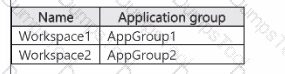
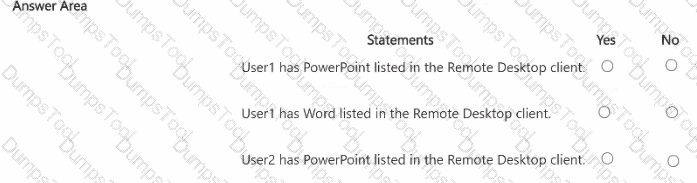
For each of the following statements, select Yes if the statement is true. Otherwise, select No.
NOTE: Each correct selection is worth one point.
Note: This question is part of a series of questions that present the same scenario. Each question in the series contains a unique solution that might meet the stated goals. Some question sets might have more than one correct solution, while others might not have a correct solution.
After you answer a question in this section, you will NOT be able to return to it. As a result, these questions will not appear in the review screen.
You have the following:
A Microsoft 365 E5 tenant
An on-premises Active Directory domain
A hybrid Azure Active Directory (Azure AD) tenant
An Azure Active Directory Domain Services (Azure AD DS) managed domain
An Azure Virtual Desktop deployment
The Azure Virtual Desktop deployment contains personal desktops that are hybrid joined to the on-premises domain and enrolled in Microsoft Intune.
You need to configure the security settings for the Microsoft Edge browsers on the personal desktops.
Solution: You configure a configuration profile in Intune.
Does this meet the goal?
Your network contains an on-premises Active Directory domain that syncs to an Azure Active Directory (Azure AD) tenant. The domain contains the domain controllers shown in the following table.

The DNS servers are configured to forward requests to an external DNS service.
You create a new virtual network named VNET2 that is peered to VNET1 and has gateway transit enabled.
You plan to implement an Azure Virtual Desktop host pool in VNET2. The session hosts will be joined to the Active Directory domain.
You need to configure DNS to meet the following requirements:
Ensure that Azure Virtual Desktop users can resolve on-premises servers and Azure resources.
Ensure that azure Virtual Desktop remains operational if a DNS server fails.
Minimize administrative effort.
What should you configure?
You have an Azure Virtual Desktop deployment.
You plan to create the host pools shown in the following table.
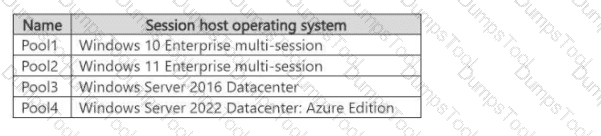
You plan to provide external users with access to the session hosts.
You need to ensure that connections to Azure Virtual Desktop are licensed by using per-user access pricing.
To which host pools will per-user access pricing apply?
You have an Azure Virtual Desktop deployment.
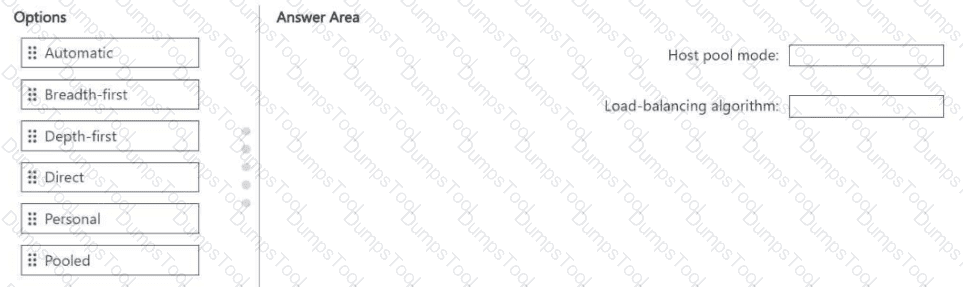
You plan to create a new host pool that meets the following requirements:
• Supports up to 25 user connections
• Contains 10 Windows 11 multi-session hosts
• Evenly distributes user sessions across the session hosts
You need to recommend which type of host pool and load-balancing algorithm to use.
What should you recommend? To answer, drag the appropriate options to the correct targets. Each option may be used once, more than once, or not at all. You may need to drag the split bar between panes or scroll to view content.
NOTE: Each correct selection is worth one point.
Note: This question is part of a series of questions that present the same scenario. Each question in the series contains a unique solution that might meet the stated goals. Some question sets might have more than one correct solution, while others might not have a correct solution.
After you answer a question in this section, you will NOT be able to return to it. As a result, these questions will not appear in the review screen.
You have the following:
A Microsoft 365 E5 tenant
An on-premises Active Directory domain
A hybrid Azure Active Directory (Azure AD) tenant
An Azure Active Directory Domain Services (Azure AD DS) managed domain
An Azure Virtual Desktop deployment
The Azure Virtual Desktop deployment contains personal desktops that are hybrid joined to the on-premises domain and enrolled in Microsoft Intune.
You need to configure the security settings for the Microsoft Edge browsers on the personal desktops.
Solution: You configure a compliance policy in Intune.
Does this meet the goal?
You have a shared image gallery that contains the Windows 10 images shown in the following table.
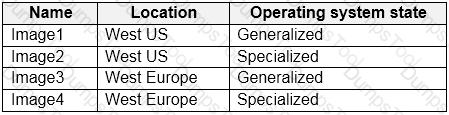
You create a Windows Virtual Desktop deployment that has the following settings:
Host pool name: Pool1
Location: West US
Host pool type: Personal
Which images can you use for the session hosts?
You have an Azure subscription that contains an Azure Virtual Desktop pooled host pool named Pool1 in the Azure East US region. You create the scaling plans shown in the following table.
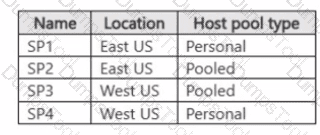
Which scaling plans can be assigned to Pool1?
Your network contains an on-premises Active Directory domain named contoso.com.
You have an Azure subscription that contains the resources shown in the following table.
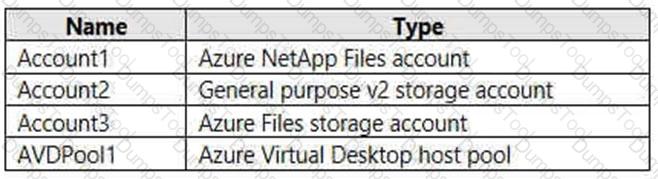
You need to create a share that will host FSLogix profiles for AVDPool1. The solution must meet the following requirements:
* Maximize read and write performance for the profiles.
* Control access to the SMB share by using the users and groups stored in contoso.com.
Which account should you use to host the share?
You have an Azure subscription that contains a user named User1 and an Azure Virtual Desktop deployment. The deployment contains the resources shown in the following table.
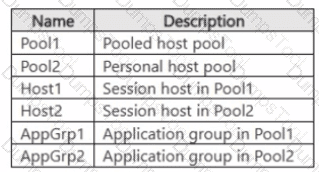
You need to assign User1 to the Azure Virtual Desktop deployment To which resources can you assign User1?
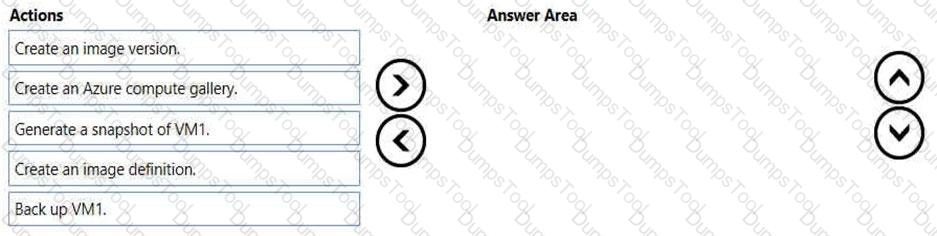
You have an Azure subscription that contains a virtual machine named VM1. VM1 runs a customized version of Windows 10 Enterprise.
You generalize the operating system on VM1 and shut down the virtual machine.
You need to deploy additional virtual machines based on an image of VM1 by using the Azure portal.
Which three actions should you perform in sequence? To answer, move the appropriate actions from the list of actions to the answer area and arrange them in the correct order.
Select and Place:
Note: This question is part of a series of questions that present the same scenario. Each question in the series contains a unique solution that might meet the stated goals. Some question sets might have more than one correct solution, while others might not have a correct solution.
After you answer a question in this section, you will NOT be able to return to it. As a result, these questions will not appear in the review screen.
You have an Azure Virtual Desktop deployment
You need to ensure that users are signed out automatically when they disconnect from a session.
Solution: From the Local Group Policy Editor, you configure the Connections settings.
Does this meet the goal?
You have a Windows Virtual Desktop host pool that runs Windows 10 Enterprise multi-session.
You need to configure automatic scaling of the host pool to meet the following requirements:
Distribute new user sessions across all running session hosts.
Automatically start a new session host when concurrent user sessions exceed 30 users per host.
What should you include in the solution?
You have an Azure subscription that contains a user named User1 and an Azure Virtual Desktop host pool named Pool1. Pool1 contains Microsoft Entra joined session hosts. User1 has the devices shown in the following table.
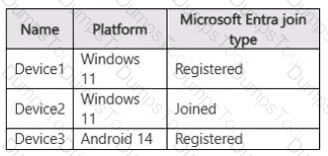
You need to ensure that User! can connect to the session hosts in Pool! from each device. The solution must minimize administrative effort
What should you do?
-
You have an Azure Virtual Desktop host pool that contains 10 session hosts.
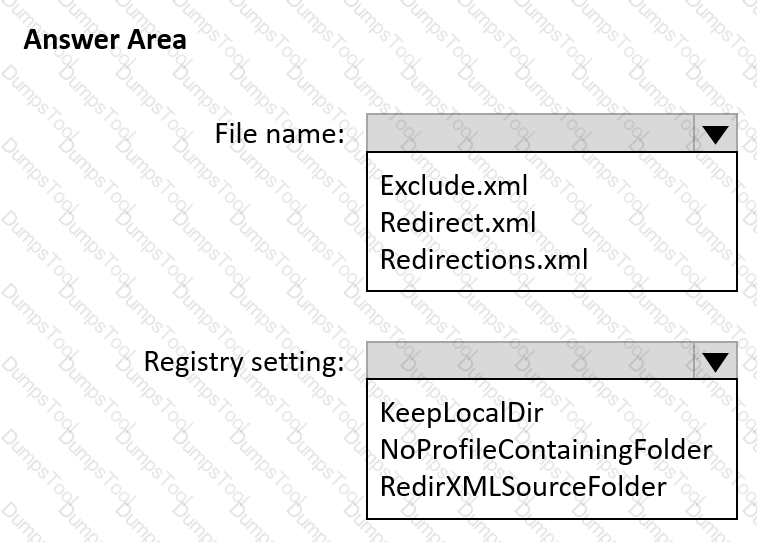
You plan to configure each session host to use an FSLogix profile container that will exclude specific folders in the user profile.
You need to perform the following configurations:
• Create a configuration file to list the excluded profile folders.
• Identify which registry setting will distribute the file to each session host automatically.
What should you name the configuration file, and which registry setting should you identify? To answer, select the appropriate options in the answer area.
NOTE: Each correct selection is worth one point.
Your on-premises network contains 20 Windows 10 devices.
You have an Azure Virtual Desktop deployment.
You need to deploy the Microsoft Remote Desktop client (MSRDC) to the devices. The MSRDC must be available to everyone who sign in to the devices.
What should you do?
You have an Azure Virtual Desktop deployment that contains 20 session hosts
You need to design a solution for the session hosts that provides security recommendations for misconfigurations, vulnerability assessment, and threat detection.
What should you include in the solution?
What should you include in the solution?
You have an Azure subscription that contains the resources shown in the following table.

You need to ensure that users can restore files saved to their FSLogix profile.
What should you do?
You have an Azure subscription named Sub1 and a Microsoft 365 E5 subscription.
The tenant contains user accounts for all internal users and users from a partner company named Fabrikam, Inc. Each internal user is assigned a Microsoft 365 E5 license. The users at Fabrikam are not assigned any licenses.
Sub1 has an Azure Virtual Desktop deployment that contains a host pool named Pool1. Pool1 contains a RemoteApp named Appl.
You need to configure access to App1. The solution must meet the following requirements:
• The Fabrikam users must be licensed by using Per-user access pricing.
• App1 must be accessible to all the internal and Fabrikam users.
• Costs must be minimized.
What should you do first?
You have an Azure Virtual Desktop host pool named HostPool1. HostPool1 contains Windows 10 session hosts and the application groups shown in the following table.
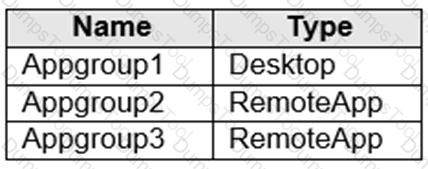
You need to assign an instance of a Windows 11 Desktop application group to users.
What should you do first?
-
Your on-premises network contains an Active Directory domain that syncs with an Azure AD tenant.
You have an Azure Virtual Desktop host pool that contains Windows 11 session hosts joined to the domain.
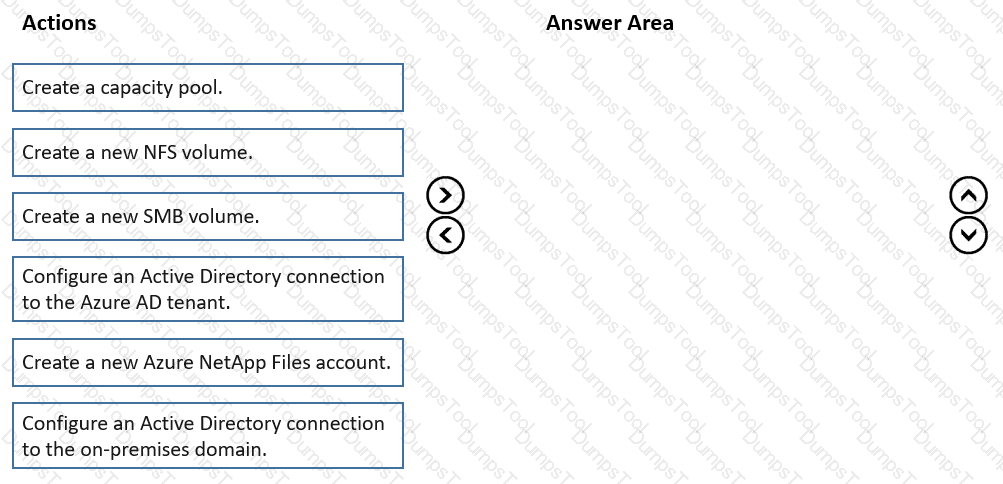
You need to configure Azure NetApp Files to store user profile containers.
Which four actions should you perform in sequence? To answer, move the appropriate actions from the list of actions to the answer area and arrange them in the correct order.
NOTE: More than one order of answer choices is correct. You will receive credit for any of the correct orders you select.
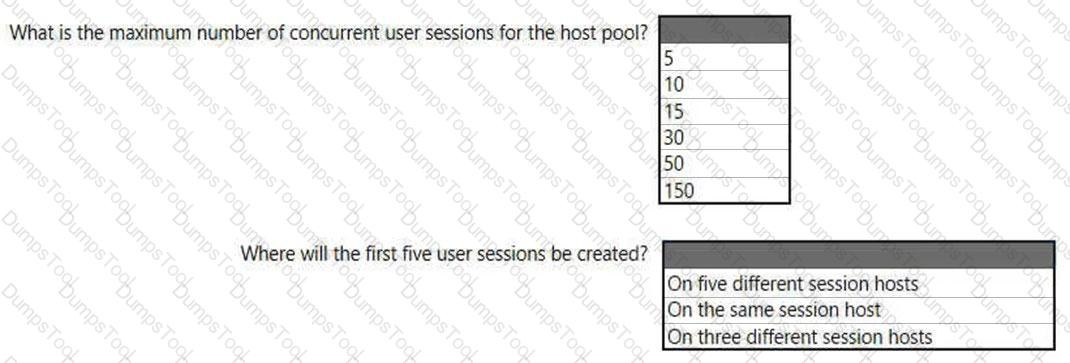
You create an Azure Virtual Desktop host pool as shown in the following exhibit.
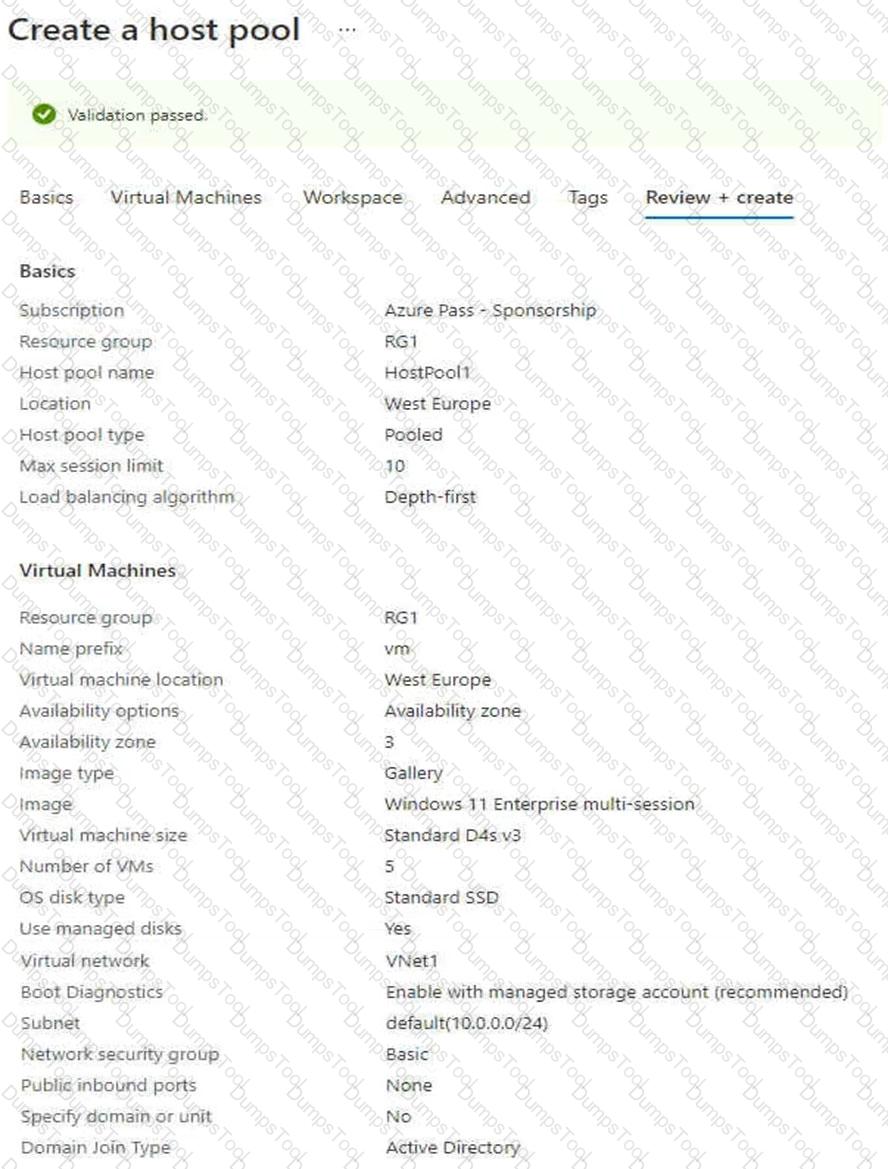
Use the drop-down menus to select the answer choice that answers each question based on the information presented in the graphic.
NOTE: Each correct selection is worth one point.
Hot Area:

TESTED 19 Oct 2026


